

Important: Do not use any retinoids if pregnant or breastfeeding!
- My Retinoid Selection: The Varieties I Use in My Skincare Routine
- My Retinoid Routine: A Detailed Explanation of Application
- Research vs. Reality: Examining Study Findings and Personal Results
This will be my final article on retinoids… I know I’ve been talking a lot about this skincare superstar lately, but it’s the talk of the town among skincare enthusiasts. It’s something that people are really curious about and have loads of questions regarding such as how do you use them? When do you incorporate them in your routine? Do they irritate your skin? Etc.
As I mentioned in my previous article (you can read here), I’ve been incorporating retinoids into my skincare routine since completing my acne treatment with isotretinoin. My dermatologist suggested it to help maintain the results I achieved during my isotretinoin treatment.
In that previous article, I mentioned experiencing occasional acne breakouts since finishing my treatment, including a flare-up during New Year’s Eve. Indeed, I had three big cystic acne spots appear on my neck (you can see the pictures in my article here). However, I’ve since adjusted my routine, and I’m confident to say that I haven’t had any more cystic acne breakouts. You can read more about my updated and complete routine in my previous article “My Skincare Routine After Isotretinoin: How I Care for My Skin Post-Treatment“.
I’ve also written an article explaining what exactly retinoids are, the differences between them, and their effectiveness based on studies, which you can find here, to help you understand this popular skincare ingredient.
But what’s equally important is how to use them. Retinoids are highly photosensitive and can make the skin very sensitive and prone to irritation. Therefore, using them correctly is crucial for long-term use without irritation.
Curious to dive deeper into retinoids?
Get my 32-page beginner-friendly retinoid guide for free when you subscribe [here], or grab it anytime on Gumroad for just €4.90 [here]!
That’s the magic of this ingredient; you need to use it consistently for a significant period before seeing any noticeable difference in your skin, and it’s best to do so without experiencing irritation.
It is important to say also that I always put sunscreen on in the morning (before going somewhere, not when I am home)! As said, retinoids are highly photosensitive and protecting your skin is a must to obtain good results!
My Retinoid Selection: The Varieties I Use in My Skincare Routine
Firstly, after completing my isotretinoin treatment, I had to wait for about a month before introducing retinoids to my skincare routine. My skin was still recovering from the treatment, and I needed to allow time for the dryness (one of the side effects of isotretinoin) to diminish.
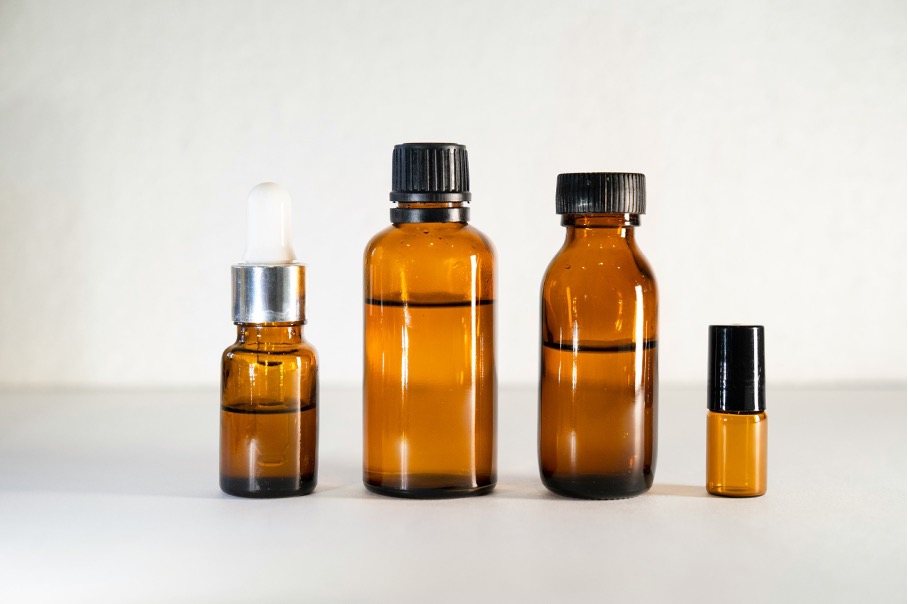
In my routine, I used to apply tretinoin 0.05% to my face as prescribed by my dermatologist – and it suits me very well. However, as of the time I’m writing and posting this article, I’ve switched to using 0.1% tretinoin. Indeed, the 0.05% version was unavailable in France and Belgium, so my dermatologist recommended a custom-made cream by the pharmacist as an alternative. Since I started incorporating tretinoin into my routine with the 0.05% strength, my article will be focused on this percentage!
N.B: However, currently, I can’t provide any further updates on whether I’ve seen more results with 0.1% tretinoin compared to 0.05%, as I only started using it 2 months ago. But what I can say is that I didn’t need to “relearn” to tolerate the cream. I easily incorporated the 0.1% thanks to the tolerance acquired with the 0.05%!
On my neck, I use a 1% retinol product. Retinol is known to be less irritating compared to tretinoin. Initially, I tried using tretinoin 0.05% on my neck, but after just two-three days, I developed eczema. Consequently, I opted for the less irritating option of retinoids, retinol.
(N.B: My retinol from the Inkey List is almost finished, and I’m considering switching to a retinal product for my neck. As mentioned in my previous article, retinal requires only one transformation on the skin, whereas retinol requires two, potentially reducing the time needed for it to work compared to retinol. That’s why I’m interested in trying retinal.)
My Retinoid Routine: A Detailed Explanation of Application
On my face
One month after completing my acne treatment, I began using tretinoin 0.05% on my face. After washing my face with a hydrating cleanser (I use it from Monday to Thursday, as mentioned in my final post-isotretinoin skincare routine here), I would wait until my skin was slightly damp before applying (balm) moisturizer.
At that time, I kept my skincare routine very simple, as I had just finished isotretinoin treatment, so I didn’t include the serum (Zinc, Copper, Niacinamide) and other anti-acneic facewash that I use now and you can see in my complete skincare routine here.
NB: In this article, I only focus on retinoids in my skincare routine but if you want to see my complete and most recent skincare routine with the products I currently use (retinoids included – except tretinoin 0.1% as it’s very new and handmade by the pharmacist), click here!
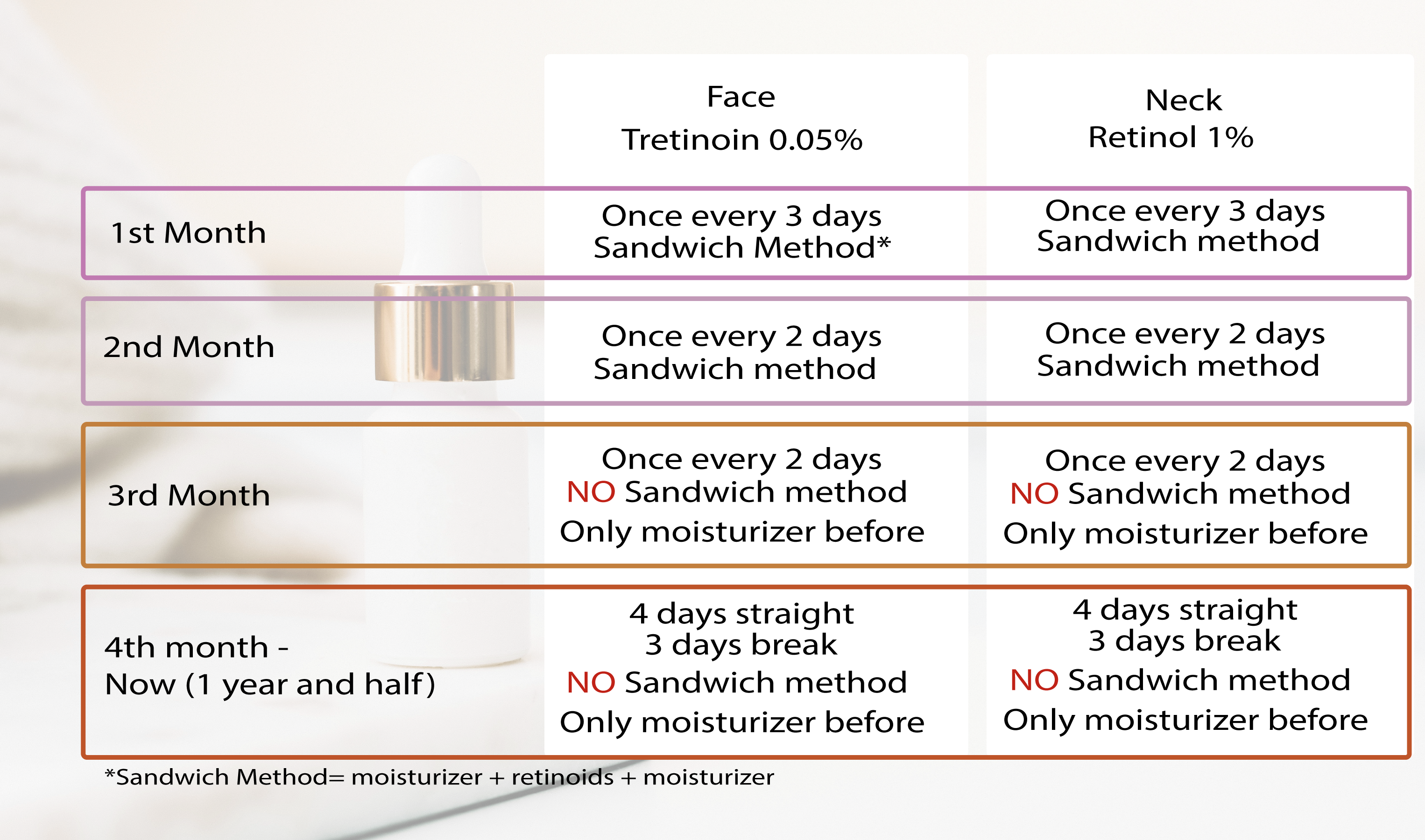
I started with the sandwich method, which involves sandwiching the tretinoin between layers of moisturizer. So, it went like this: moisturizer, tretinoin, moisturizer.
The amount of tretinoin I used, and still use, on my face is equivalent to one and a half pea-sized amounts. Despite recommendations from dermatologists to use just a pea-sized amount, I found that it wasn’t enough for me. Increasing it to one and a half pea-sized amounts works best for my skin as I can spread it evenly all over my face.
Initially, I avoid applying tretinoin directly under my eyes and in the outer corners of my eyes (where crow’s feet typically form). Instead, I would spread the cream all over my face first, and then use the leftover cream on my hand to apply under the eyes and in the outer corners. I found this method less irritating.
In the beginning, I could only use tretinoin once every three days. I initially tried to use it daily, but my skin became very sensitive, and eczema started to develop very quickly. So, during the first month of use, I reduced my application to every three days.
On my neck
Similarly, I started using tretinoin 0.05% on my neck, but it was too irritating. After just three days, my neck began itching and eczema appeared. So, I switched to using retinol 1% instead.
Again, I used the sandwich method on my neck with retinol, and experienced no irritation.
And on my neck, the amount of retinol used, and still use, is equivalent to only a pea-sized (less than on my face). I could use retinol every day without any issues as I found it way less irritating than tretinoin on my face (despite the fact that I use retinol 1%).
I wanted to maintain a consistent routine for both my neck and face. So, to start, I used retinol once every three days, like tretinoin.
I stuck with this routine for about a month: tretinoin on my face and retinol on my neck, every three days and both with the sandwich method.
In my second month of use, I added an extra day to my routine, still with the sandwich method. So, I was using tretinoin on my face and retinol on my neck once every two days.
After two months, I continued using retinoids every two days, but without the sandwich method, just applying moisturizer before the cream.
N.B: I’ve never tried applying moisturizer after the retinoids and still never do it. I think it’s because I apply moisturizer before that my skin can tolerate the retinoids better. I really feel the need for this “buffer” before application to avoid irritation.
After three months, I wanted to try using retinoids every day, but after a week, I could feel my skin becoming sensitive. Even now, a year and a half later, I still can’t tolerate daily use. I’ve found that I can tolerate four days in a row without sensitivity, so I’ve stuck to using retinoids from Monday to Thursday and then giving my skin three days of intense hydration.
When I say sensitivity, I mean that my skin tingles when I wash my face and I could see some part of my face peeling like around the nose, around the mouth and chin.
Since building up my tolerance to retinoids, specifically tretinoin on my face (as I’ve never experienced sensitivity with retinol), I no longer have eczema on my face. Occasionally, I might get a small eczema spot around the cheekbone, but it’s usually tiny and disappears after avoiding tretinoin in that area for a few days (and after applying baby rash cream on those eczema spots, a trick I’ve been using for 15 years).
NB: I believe it also depends on the moisturizer you use. Just two months ago, I switched from Cerave cream to Bioderma, and after Thursday, I no longer feel sensitivity or at least less. And keep in mind that I’ve increased the tretinoin strength from 0.05% to 0.1% also two months ago! Good note to keep in mind! (Can’t give you my feedback on the efficacity/difference I see with 0.1% yet, but would like an update later on?)
So, from month four until now, a year and a half later, I’ve stuck with this routine. I tried using retinoids daily again, but my skin is still too sensitive, so I’ve settled on Monday to Thursday for retinoids (tretinoin on my face and retinol on my neck), followed by three days of intense hydration.
In summary:
Just a few months ago, I added an acne cleanser during those three days of recuperation but that you can see my complete and most recent skincare routine in details here!
I want to point out that all the products I use in my skincare routine, including the tretinoin and retinol, which I’ve been using and still use, by the way, you can find them here! NB: I mentioned earlier that I switched to 0.1% tretinoin (out of “obligation”), which is a mixture made by the pharmacist and prescribed by my dermatologist, so it’s not in the article!
Research vs. Reality: Examining Study Findings and Personal Results
A study conducted over 12 to 24 weeks of consistent use revealed significant improvements in age-related skin concerns such as fine lines and uneven pigmentation.1
Notably, the study found effectiveness with concentrations of 0.1% and 0.05% for tretinoin, and 0.1% for retinol. Consistent use of tretinoin and retinol can lead to significant improvements in photodamage as early as 4 weeks, with continued enhancement over several months, as highlighted in the study.2
In my personal experience, I noticed improvements in blackheads after about a month of initial use. Following the completion of my isotretinoin treatment, blackheads began reappearing on my nose, albeit not as prominently as before.
After a month of incorporating retinoids into my routine, I observed a gradual disappearance of blackheads on my nose. Fast forward to today, a year and a half later, and the blackheads have almost completely vanished.
Initially, I didn’t notice significant changes apart from the reduction in blackheads. However, after a year and a half of consistent use, I began to notice improvements in fine lines, particularly around my eyes. There’s a specific fine line under my left eye that extends down to my cheekbone, which has started to fade. It’s becoming less prominent and less deep over time.
Overall, today my complexion appears clearer and more radiant. However, I still experience occasional acne breakouts!
In summary, my experience with retinoids has been a journey of gradual improvement and discovery. Starting from post-isotretinoin blackheads to embracing the consistent use of tretinoin and retinol, I’ve witnessed significant changes in my skin. My skin is more radiant and plumper!
Despite occasional challenges, such as sensitivity and acne flare-ups, the results speak volumes.
The study’s findings align with my personal observations, highlighting the effectiveness of retinoids with consistent use over time. As I continue on this skincare journey, I’m reminded of the importance of patience and dedication.
Retinoids have become a valuable asset in my skincare routine, offering promising outcomes and motivating me to persist in achieving my skincare goals.
And you? Have you incorporated retinoids into your routine? How has it been?
Let me know in the comments below!
See you soon,
Beautifully Moi!
- National Library of Medicine; “Retinoids in the treatment of skin aging: an overview of clinical efficacy and safety” ↩︎
- National Library of Medicine; “Retinoids in the treatment of skin aging: an overview of clinical efficacy and safety” ↩︎


[…] English version here […]
LikeLike
[…] I’ve been using tretinoin for two years now. You can check out my full routine with tretinoin [here]. Tretinoin works by speeding up skin cell turnover and regulating oil production. But since […]
LikeLike
[…] Until now, I had only used retinol or retinal (two gentler forms of vitamin A; you can read more here if you want the details of this skincare routine and if you want to know the difference between the […]
LikeLike