

- My Skin Issues
- What is the Visia Facial Analysis?
- Preparation before the appointment: no makeup and natural
- The process of the analysis: black cape, headband, and photos
- My results with the Visia Facial Analysis
- My Personalized Skincare Plan
When starting skin treatments, there are countless options: CO2 laser, microneedling, peels, etc. It’s easy to feel overwhelmed and uncertain about which treatment is right for your specific skin type.
I had considered microneedling at a cosmetic center, but before committing, I decided to consult a dermatologist for a thorough evaluation. After years of battling acne, stabilized with isotretinoin, I am now ready to achieve the skin I’ve always dreamed of. This appointment was the perfect opportunity to better understand my skin and receive personalized advice.
In 2019, after stabilizing my acne, I tried a glycolic acid peel (three sessions). While it showed improvements, the acne unfortunately returned. I quickly realized that deeper treatments would be necessary for lasting results. (I’ll dedicate an entire article to my experience with this peel, complete with photos, in an upcoming post!)
It was with skin in transition that I went to this appointment, eager to receive a detailed evaluation and recommendations to improve my skin’s texture.
My Skin Issues
My acne journey has been long, from the age of 14 to 35. Initially, it was juvenile acne, concentrated on my forehead and temples. By 23, it spread to my jaw. Between 26 and 34, there was a calmer period (with zinc), and while my skin wasn’t perfect, I considered it “beautiful” compared to before. Read more, here My Skincare Journey: The Early Struggles – Part 1 and My Skincare Journey: Navigating Acne and Rosacea: The Early Struggles – Part 2
Despite being scared of isotretionin due to negative stories, at 35, I decided to give it a try after years of imperfections. Read my accutane experience here: My Quest for Perfect Skin with Isotretinoin: An Intimate Journey
The years of acne have left scars, especially on my forehead, which remains my biggest insecurity (see my forehead in this article: Sebaceous Hyperplasia: My Story).
During my consultation, the dermatologist examined my skin and told me that despite my history with acne, I had beautiful skin.
However, she clarified that these were not acne scars, but rather a marked texture, with visible pores still present on my forehead, nose, and the lower part of my cheeks. She suggested performing a full skin analysis using “Visia Facial Analysis” technology.
What is the Visia Facial Analysis?
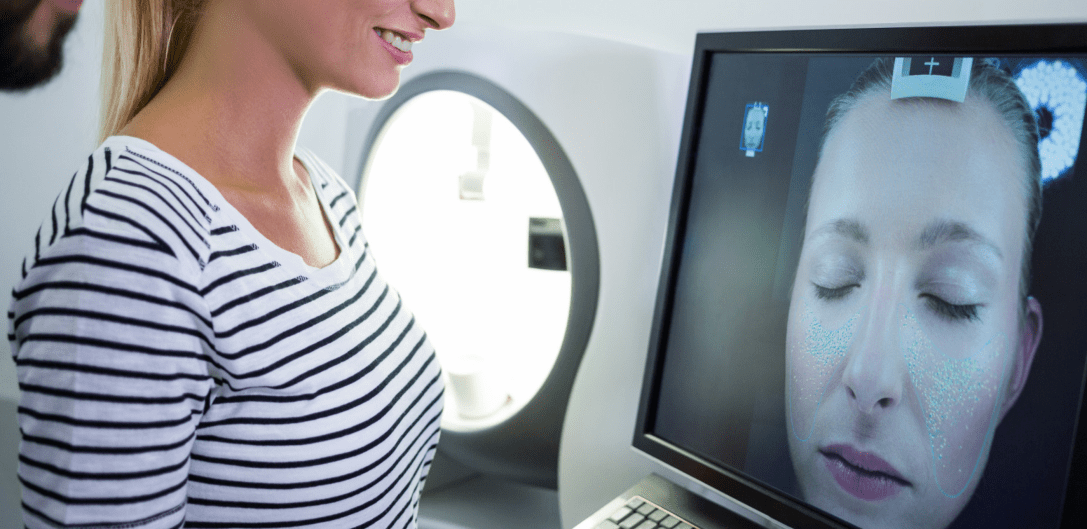
The Visia Facial Analysis is an advanced technology that allows for a deep examination of the skin. Using high-definition images and UV light, it can detect elements invisible to the naked eye: pigmentation spots, wrinkles, texture, pores, UV damage, redness, and even bacteria in the pores. The results are presented in percentages, comparing your skin to that of other people of your age, gender, and skin type. This provides a precise evaluation of your skin’s needs and helps define personalized treatments. What’s great about this analysis is that it also detects signs of aging or underlying damage before they are visible to the naked eye.
Preparation before the appointment: no makeup and natural
I find it more relevant to come without makeup for this type of appointment, as it allows the dermatologist to examine my skin in its most natural state. This helps to better identify the real problems.
If you arrive with makeup on, no worries, you will just be asked to remove it before the analysis. It is also recommended to avoid certain irritating treatments before the consultation (such as tretinoin or other retinoids), as they could skew the results. Additionally, avoid greasy creams or oils, as they can leave a film on the skin.
The process of the analysis: black cape, headband, and photos
Once I was makeup-free (or not if you came with ‘natural skin’), I was placed under a cape and a black headband to maximize the contrast of the images. Then, I just had to rest my chin on a support, close my eyes, and the machine took photos from different angles (front, left, and right). This took less than a minute. The step is quick, painless, but there is a fairly intense light flash.
My results with the Visia Facial Analysis
The results were instant and provided an overview of my skin with numbers. This percentage corresponds to my ranking compared to other people of the same age, gender, and skin type.
How to interpret Visia Facial Analysis results?
It’s important to understand that some scores are better when the percentage is higher (“spots,” “wrinkles,” “texture pores,” “brown spots,” and “red areas”), while others are better when lower (“UV spots” and “Porphyrins”).1
. “Wrinkles”: Measures the appearance of wrinkles and fine lines; a higher score means fewer visible wrinkles.
. “Spots”: Includes pigmentation and blemishes; a higher score means fewer visible spots.
. “Pores”: Measures the size and visibility of pores; a low score indicates less visible pores.
. “Texture”: Indicates collagen and elastin quality; a higher score means smoother skin texture.
. “Porphyrins”: Bacteria in pores, often linked to acne; a low score means fewer bacteria.
. “UV Spots”: Measures sun damage in the form of invisible UV spots; a low score is better.
. “Brown Spots”: Measures hyperpigmentation; a high score indicates fewer brown spots.
. “Red Areas”: Analyzes redness, like rosacea or inflammation; a low score means less redness.
Here’s what it looks like for me:

The highlighted areas on the pictures correspond to spots where the machine has detected specific features, such as “spots” (pigmentation, acne marks, etc.), wrinkles, red areas etc. These areas are outlined to show exactly where these imperfections are located, providing a detailed assessment of your skin’s condition and helping to target treatments accordingly.
1. Spots: 61%
This score shows that I have fewer visible spots compared to 61% of people with the same age and skin type. I can still improve this with good sun protection and targeted care.
2. Wrinkles: 94%
An excellent score! My wrinkles are less prominent than 94% of people my age, showing my skin is well-preserved and my anti-aging routine is working.
3. Texture: 92%
My skin texture is better than 92% of people my age, reflecting smooth, even skin. I’m happy with this result but will keep taking care of it.
4. Pores: 41%
My pores are more visible than 41% of people my age, so I can improve this with purifying treatments and pore-tightening products.
5. UV Spots: 29%
This score means my skin has fewer UV spots than 29% of people my age. It indicates invisible damage, so I need to be more vigilant with daily sun protection.
6. Brown Spots: 82%
My brown spots and hyperpigmentation are well-controlled compared to others my age. I’m reassured but know I need to continue protecting my skin from the sun.
7. Red Areas: 43%
My red areas are less noticeable than 43% of people my age. My skin is still reactive, so I’ll continue using soothing treatments.
8. Porphyrins: 34%
My skin is relatively clear of bacteria and debris, with a score of 34%. I will ensure thorough cleansing and use antibacterial products to improve this further.
What these results taught me about my skin:
Overall, the analysis provided a clearer view of my skin’s condition and specific needs. The strong points (wrinkles and texture) reassure me about my current routine, while the lower scores (pores, UV spots, and porphyrins) highlight areas for improvement.
The photo that struck me the most during the Visia analysis was the one highlighting the “UV spots.” Seeing the sun damage on my skin was a real shock; I didn’t think I had so many. Looking back at my years of not protecting my skin, especially during my vacations in Turkey, I realize just how crucial it is to protect your skin from the sun, particularly during childhood. So, protect yourself!
With this precise data, I can now target my treatments more effectively, focusing on sun protection, cleansing, and soothing redness. One thing is certain: this tool is a real ally in better understanding and treating my skin smartly.
My Personalized Skincare Plan
The dermatologist confirmed that my current routine was already well adapted, especially with tretinoin and azelaic acid (Read my skin care routine here: My Skincare Routine After Isotretinoin: How I Care for My Skin Post-Treatment and this article can be useful if you are new to the skincare world: A Minimalist’s Skincare Routine). She suggested reducing the frequency of tretinoin to twice a week in winter due to potential redness caused by the cold.
Curious to dive deeper into retinoids?
Get my 32-page beginner-friendly retinoid guide for free when you subscribe [here], or grab it anytime on Gumroad for just €4.90 [here]!
However, she also explained that to achieve long-lasting results, a deeper treatment would be necessary. Given my acne history and my previous experience with peeling, it’s clear that my skin needs more powerful treatments to improve its texture and address persistent skin issues. She recommended LaseMD.
Treatments like microneedling, CO2 laser, and peels are often discussed, but LaseMD, a non-invasive laser treatment, is still relatively unknown.
However, during my consultation, the dermatologist explained the treatment well, although I admit I forgot some details afterward.
That’s why I want to share my research with you and write a complete article about LaseMD, its benefits, and how it works, so you can better understand the treatment and see if it might meet my needs, and maybe yours too! (read article on LaseMD here)
In summary, this dermatology appointment helped me better understand the state of my skin and receive personalized advice. Thanks to the Visia analysis, I was able to visualize my skin’s strengths and weaknesses, allowing me to target my care more precisely. Although my routine is already well adapted, it seems that a deeper treatment is necessary to achieve the long-term results I’m looking for.
I look forward to sharing with you the progress of my skin after this treatment. One thing is certain: with the right care and advice, we can always keep progressing, even after years of battling acne!
See you soon, Beautifully Moi!
 Beautifully Moi
[…] English version here […]
LikeLike
[…] my dermatologist analyzed my skin using the Visia Facial Analysis, one image stood out: the UV spots photo. Seeing the sun damage hidden beneath the surface was a […]
LikeLike
[…] undergoing a Visia facial analysis, I discovered fascinating insights into my skin’s condition. My Visia results gave me a detailed […]
LikeLike
[…] I went to the dermatologist, you can read the full diagnosis of my skin here and the treatments she recommended me […]
LikeLike